Understand your risks. Prioritize your security investments.
Cadre's Informal Risk Assessment gives you a clear picture of your organization's security posture, identifies gaps in your defenses, and helps you determine where to focus your time, attention, and budget.
Our experienced security practitioners work with your team to understand your business, evaluate your existing security practices, and develop actionable recommendations aligned with your organization's goals. The result is a practical roadmap for making smarter security decisions—without the time and expense of a large-scale formal assessment.
Your business, operations, and security needs are unique. Your risk assessment should be, too.
Cadre tailors each assessment to your organization's current state, objectives, and desired scope. Our Trusted Advisor team works with stakeholders across your organization to understand your business processes, security responsibilities, policies, data use, access controls, business continuity planning, and incident response practices.
We use stakeholder interviews, relevant documentation, and a structured review process to develop a practical assessment grounded in how your organization actually operates.
Our approach is designed to deliver useful insights in weeks, not months.
Learn more
A strong security program starts with understanding the risks your organization faces and why they matter to your business. Cadre's Informal Risk Assessment helps you connect risks to the policies, controls, processes, and training designed to mitigate them.
With a clearer picture of your current security posture, you can:
Whether you're establishing a security program, reassessing existing controls, preparing for compliance obligations, or determining where to invest next, Cadre can help you turn uncertainty into a practical plan.
An effective risk assessment requires more than a checklist. It requires an understanding of information security, business operations, and the relationships between risk, controls, and organizational objectives.
Cadre's experienced information security practitioners bring assessment and auditing expertise to the process, helping you move beyond assumptions and self-assessments to develop a more objective view of your security posture.
Our Informal Risk Assessment is available through Cadre's Trusted Advisor and vCISO service tiers, with additional scope and support options available to meet your needs.


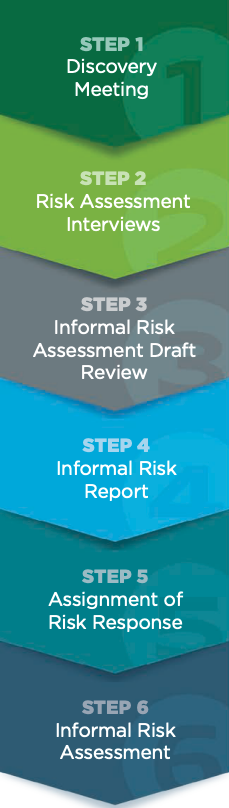
1. Discovery
We meet with key stakeholders to understand your organization and identify the people best positioned to contribute to the assessment.
2. Stakeholder interviews
Our team gathers insights into your business processes, security objectives, responsibilities, policies, and existing controls. Interviews can take place remotely or in person.
3. Draft review
We compile the findings into a draft assessment and work with your team to validate the information, clarify gaps, and ensure the report accurately reflects your environment.
4. Risk assessment report
You receive a documented view of the risks identified through the assessment, providing a foundation for informed decision-making and security planning.
5. Risk response planning
Cadre's Trusted Advisor works with your designated stakeholders to determine how to respond to identified risks and establish appropriate next steps.
6. Actionable security guidance
Use the completed assessment to guide security policies, control selection, budget decisions, maturity goals, and future improvement initiatives.
Depending on your organization's needs and the assessment's scope, deliverables and optional support may include:
Security consultants offer many kinds of assessments, and the differences are easy to blur. Here is how these two compare.
Risk assessment
A strategic tool for senior leaders: the Board of Directors, C-level executives, directors and department or program heads. It guides policy, budgets and objectives. It also provides evidence of due diligence and due care.
Vulnerability assessment
A tactical tool for IS/IT managers. It documents the results of a network or device scan, helps spot configuration issues and can confirm a degree of compliance to frameworks. Directors of IT or IS typically receive an executive summary.